Dobbs training plan: London Marathon 2027
Race day: Saturday 24 April 2027 · Training starts: Monday 14 September 2026 · 32 weeks
The 2027 London Marathon is a one-off two-day “Double” and Dobbs is running the Saturday. Long runs stay on Sundays through training; race week simply compresses by a day, and the last couple of long runs move to Saturdays to rehearse the race-day routine.
The goal
A comfortable sub-4:30 first marathon. That means averaging 6:24/km for 42.2 km.
Your 2:07 half marathon (6:01/km) already predicts roughly a 4:25 marathon on the standard Riegel conversion, if you do the endurance training. So sub-4:30 is honest and achievable: it doesn’t require you to get faster, it requires you to get durable. That’s what the next 32 weeks are for.
The paces that matter:
| Pace | Per km | Used for |
|---|---|---|
| Easy / long run | 7:00–7:30 | ~80% of all running. Fully conversational |
| Marathon race pace | 6:24 | Short segments inside later long runs |
| Steady / tempo | 6:00–6:10 | Midweek quality run, from phase 2 onwards |
If easy pace feels insultingly slow, it’s right. Running easy is what lets the volume build without breaking you.
The shape of 32 weeks
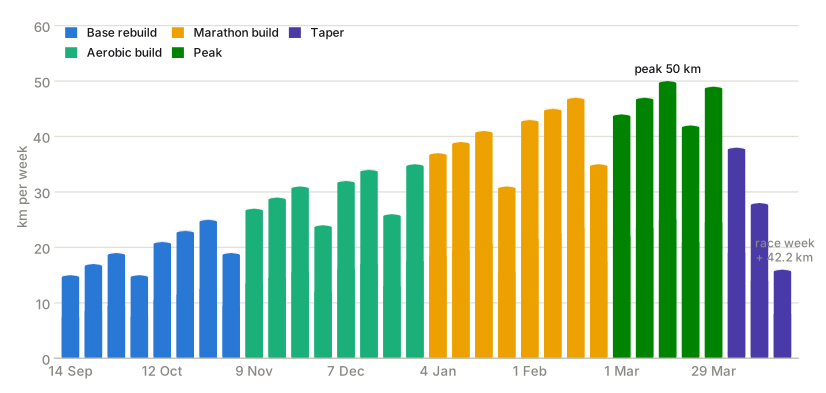
Five phases, with a cutback week roughly every fourth week (the dips in the chart are planned recovery, not slacking). About 1,020 km of training before the start line.
| Phase | Weeks | Dates | km/week | Run hours/week | Focus |
|---|---|---|---|---|---|
| 1 · Base rebuild | 1–8 | 14 Sep – 8 Nov | 15–25 | 1¾–3 | Rebuild the habit. Everything easy |
| 2 · Aerobic build | 9–16 | 9 Nov – 3 Jan | 24–35 | 3–4¼ | Long run grows; strides + gentle tempo |
| 3 · Marathon build | 17–24 | 4 Jan – 28 Feb | 31–47 | 3¾–5½ | Long runs 20–28 km; gel practice starts; tune-up half |
| 4 · Peak | 25–29 | 1 Mar – 4 Apr | 42–50 | 5–6 | Two 30+ km runs; full race rehearsals |
| 5 · Taper | 30–32 | 5 Apr – 24 Apr | 38→16 | tapering | Absorb the training. Arrive fresh |
Add ~45 minutes of strength on top of the running hours. Peak total commitment is about 6½–7 hours a week, for five weeks in March. Everything before that is gentler.
The week
Seven days, fully accounted for: 4 runs + 1 strength session + 2 protected rest days. The rest days are for life, not for squeezing in “just a short one”.
| Day | Session |
|---|---|
| Mon | Rest (protected) |
| Tue | Easy run |
| Wed | Strength, 30–45 min |
| Thu | Quality run (strides → tempo → race-pace work as phases progress) |
| Fri | Rest (protected) |
| Sat | Easy run (short) |
| Sun | Long run |
Shuffle freely around social plans. The only rules:
- Keep ~2 days between the quality run and the long run.
- Strength never lands the day before the long run.
- The long run is the one session that really matters each week. If life forces a choice, protect it and drop an easy run instead.
Milestones
| When | Milestone |
|---|---|
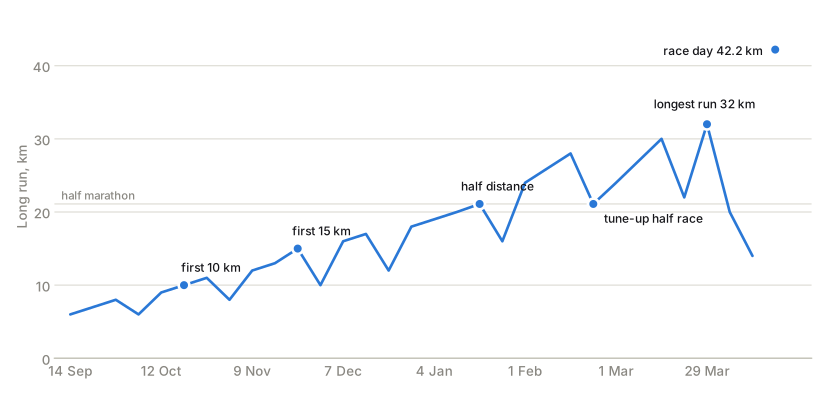
| Sun 25 Oct 2026 | First 10 km long run |
| Sun 29 Nov 2026 | First 15 km |
| Sun 24 Jan 2027 | Half-marathon distance in training (easy pace) |
| Sun 28 Feb 2027 | Tune-up half marathon race (book one near this date) |
| Sun 21 Mar 2027 | First 30 km |
| Sun 4 Apr 2027 | Longest run: 32 km, just under three weeks out |
| Sat 24 Apr 2027 | London Marathon |
The tune-up half is the single best fitness check in the plan: raced at the end of a mini-taper week, it should come in comfortably under 2:07 and confirms (or recalibrates) the sub-4:30 target with 8 weeks still to adjust.
You never run 42.2 km in training; nobody does. The taper plus race-day adrenaline and fuelling bridge the gap from 32 km.
Fuelling and gel training
Marathon fuelling is a trained skill. Guts that aren’t used to eating on the run rebel at 30 km, so we practise, starting in phase 3, on every long run of 90 minutes or more.
- Target on race day: ~40–50 g of carbohydrate per hour. With a typical gel at ~22–25 g carbs (a Maurten GEL 100 is 25 g), that’s one gel every 30–35 minutes, around 7–8 gels over the race. It sounds like a lot; that’s why we train it.
- Progression: first gel-run in January with just one gel mid-run → build to full race cadence on the 30+ km runs in March, which are dress rehearsals: race kit, race breakfast, race gels, race pacing.
- Train with what you’ll race with. Pick a brand and flavour that agrees with you and stick to it. Check what the 2027 course supplies nearer the time; if it’s not your gel, carry your own.
- Before the race: carb-heavy eating for the final 48 hours, familiar breakfast 2½–3 hours before the start.
- Drinking: little and often, to thirst. Practise grabbing and drinking from cups/bottles on the March long runs.
Strength day
One session a week, 30–45 minutes, and its job is injury-proofing, not gains: calves, glutes, hamstrings and core, with a single-leg bias (step-ups, single-leg calf raises, lunges, bridges, side planks). Runners’ injuries cluster where these are weak. Keep it consistent through phases 1–4, then drop to one light maintenance session a week during the taper.
When a week goes wrong
It will, several times, over 32 weeks. The rules:
- Never chase missed sessions. A missed run is gone; carry on with the plan. Doubling up is how injuries start.
- Miss up to a week (illness, holiday, life): rejoin the plan a step back from where you left, not where the calendar says.
- Niggles: soreness that eases as you warm up is fine. Pain that changes your stride, or gets worse during a run, means stop. Three days off now beats three months off later, and the plan has enough slack to absorb it.
- Sleep is training. The adaptation happens in recovery; the two rest days and normal bedtimes are doing as much work as the runs.
Deep-dives (coming soon)
This page is the high-level sketch. Detailed, interactive versions of each piece will appear in adhoc and be linked here:
- Week-by-week schedule: every session, every week, tickable
- Pace calculator: easy/tempo/race paces from any recent race result
- Fuelling planner: gels, timing and carbs/hour for race day
- Tune-up race analysis: recalibrating the target after the February half